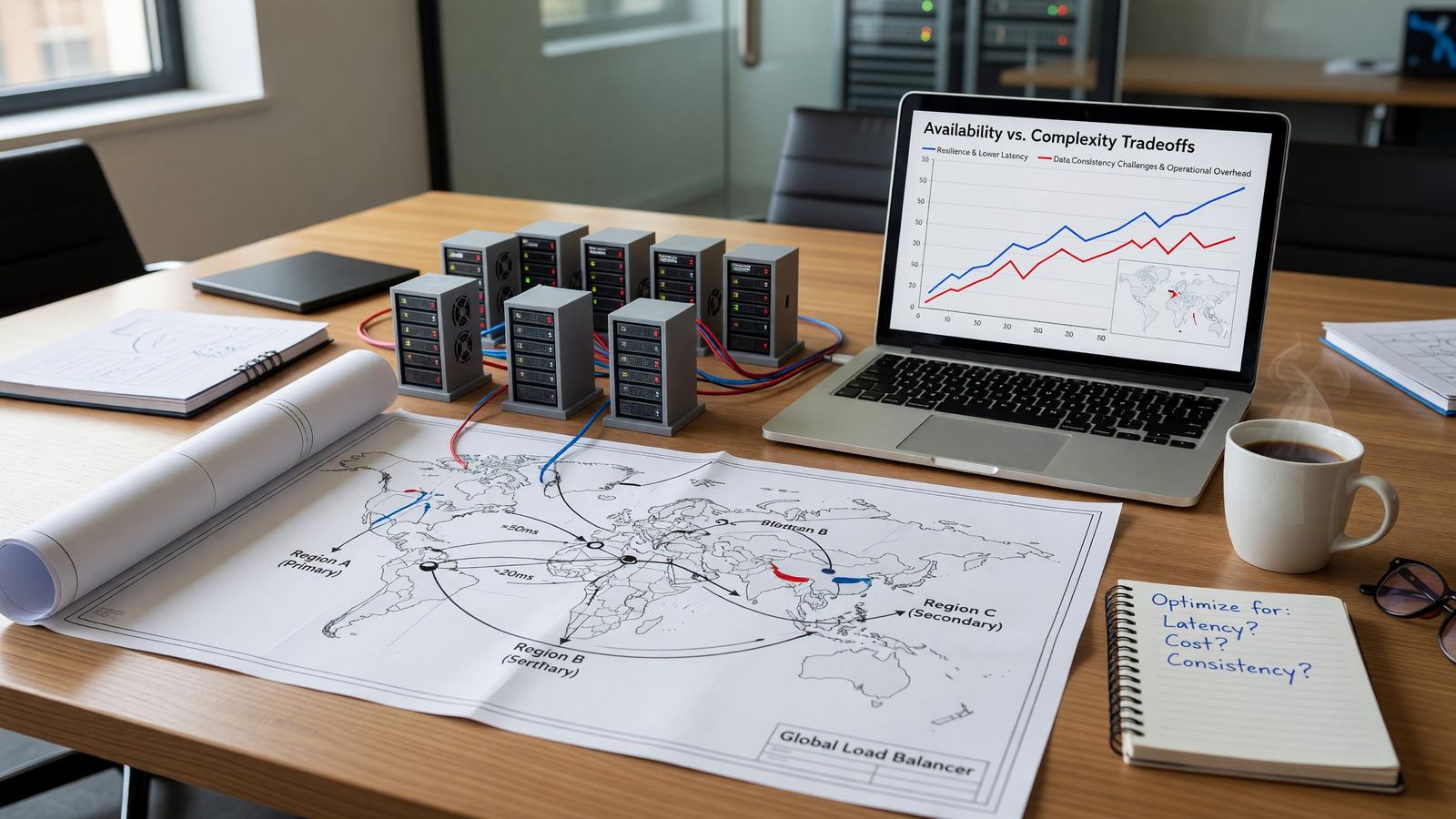
Multi-Region Deployment Strategies: Tradeoffs Between Availability and Complexity
Why Go Multi-Region
Three main drivers: tolerating a region outage, serving global users with low latency, and meeting data residency requirements. Each justifies a different architecture.
Adding regions reflexively because they sound resilient is the wrong reason. A single-region deployment with good architecture is more reliable than a multi-region deployment most teams can’t actually fail over.
Active-Passive: The Conservative Start
One region serves all traffic. A second region holds replicated data and minimal compute, ready to be promoted. Failover is manual or semi-automated and rarely tested.
Pros: simple to operate, low overhead. Cons: failover is slow and risky, the passive region is expensive infrastructure that’s mostly idle, and untested failover procedures fail when needed.
If you go active-passive, practice failover quarterly. A passive region you’ve never actually used is not a backup.
Active-Active: The Cost-and-Complexity Choice
Both regions serve traffic, typically split by user location or weighted round-robin. Data is replicated bidirectionally or partitioned by region.
Pros: real load distribution, real failover testing in production, lower per-region capacity needed. Cons: data consistency becomes hard, every service must be region-aware, and cross-region traffic costs real money.
Data Consistency Models
Strong consistency across regions is expensive and slow. Most multi-region architectures pick eventual consistency, asynchronous replication, or sharding by region.
Sharding by region (each user’s data lives in one region) is the most operationally simple. Replication for read scale-out (writes go to one region, reads serve locally) is the second simplest. Multi-master with conflict resolution is the hardest and only worth it when business requirements truly demand it.
Failover and Testing
A failover plan that hasn’t been tested doesn’t work. The first real failover under pressure is the first failover, and it goes badly more often than not.
Schedule regular GameDays: simulated region failures with the actual failover procedures. They surface the assumptions that don’t hold and the runbooks that have rotted.
Related Reading
- See our deeper guide at /cloud/gcp-vs-aws-infrastructure-comparison/.
Traffic Routing Mechanisms
DNS-based routing (Route 53 geolocation or latency-based records) is the most common multi-region traffic shaping mechanism. Simple to set up; slow to respond to changes due to DNS caching.
Anycast IP via Global Accelerator (AWS) or Premium Tier networking (GCP) gives sub-second failover by manipulating routing rather than DNS. More expensive; better failover characteristics. The right choice depends on your RTO requirements.
Disaster Recovery Tiers
The four DR tiers from least to most aggressive: backup and restore (RTO measured in hours/days, cheapest), pilot light (passive infrastructure with replicated data, RTO hours), warm standby (scaled-down running environment, RTO tens of minutes), active-active (full capacity in each region, RTO seconds). The AWS Disaster Recovery whitepaper covers these tiers in detail.
Most organizations don’t need active-active. Pilot light or warm standby is the right cost-performance balance for the vast majority of workloads. Don’t over-engineer DR; over-engineered DR that isn’t tested fails like under-engineered DR.
Data Replication Patterns
The data layer is usually the hardest part of multi-region. Synchronous replication keeps regions consistent but introduces cross-region latency. Asynchronous replication is faster but introduces lag.
For most workloads, asynchronous replication with explicit consistency boundaries is the right pattern. Each region serves reads locally; writes go to a primary region or are partitioned by user. Tolerable lag depends on workload — payment systems can’t tolerate any; analytics can tolerate minutes.
Tools like Aurora Global Database, Cloud Spanner, CockroachDB, and YugabyteDB give different points in the consistency-latency-cost tradeoff. Pick based on application requirements, not on what sounds most resilient.
Operational Complexity
Multi-region operations add proportional complexity. Configuration must propagate to all regions. Monitoring must cover all regions. Incident response involves multiple regions potentially in different states.
Tooling helps: GitOps with multi-region ArgoCD installations applies the same config everywhere. Multi-region observability shows cross-region patterns. But the underlying complexity is real — multi-region is a meaningful additional cost beyond the infrastructure itself.
Be honest about whether you need it. Many systems that ‘should’ be multi-region operate fine single-region with good DR practices. Multi-region is justified when single-region downtime is genuinely unacceptable, not when it sounds better.
Hybrid and Multi-Cloud Considerations
Few large organizations are purely single-cloud. Acquisitions, regulatory requirements, and specific service preferences all push toward multi-cloud reality. The challenge is operating consistently across the resulting environment.
Tools that help: Crossplane for multi-cloud infrastructure provisioning, Terraform for multi-provider IaC, Kubernetes as a consistent application platform across clouds. Each abstracts away some cloud-specific details at the cost of giving up some cloud-specific capabilities.
The pragmatic path is usually ‘primary cloud plus secondary’ — most workloads on one cloud with specific workloads or backup capacity on another. Pure multi-cloud parity is rarely worth the operational cost.
Tagging and Resource Governance
At any meaningful scale, cloud resource governance requires consistent tagging. Tags by team, environment, project, cost center, and compliance category enable cost attribution, security scoping, and operational filtering.
Enforcement is the hard part. IAM policies can deny resource creation without required tags. Cloud Custodian and similar policy engines can scan for non-compliant resources and remediate.
Without enforcement, tags drift. Engineers create resources for quick experiments and forget to tag. Within a quarter, untagged resources outnumber tagged ones. Build the enforcement early; retrofit is painful.
Documentation and Knowledge Management
Cloud infrastructure changes constantly. Documentation that captures architecture decisions, runbooks for common operations, and explanations of non-obvious choices preserves institutional knowledge through team turnover.
Architecture Decision Records (ADRs) are a lightweight pattern: a short document per significant decision capturing context, options considered, decision, and consequences. ADRs accumulate into a chronicle of why the architecture looks the way it does.
Living documentation beats one-time writeups. Tie documentation to code where possible — README files in repos, comments in Terraform, generated diagrams from infrastructure tools. Documentation that lives near the code it documents stays current.
Compliance and Audit Considerations
Cloud workloads often fall under compliance frameworks: SOC 2, ISO 27001, HIPAA, PCI DSS, FedRAMP. Each has specific control requirements affecting how you architect, configure, and operate.
Common cross-framework requirements: encryption at rest and in transit, access logging and review, incident response procedures, change management, vulnerability management. Building these in from the start is dramatically cheaper than retrofitting under audit pressure.
Tools that help: AWS Config and Audit Manager, GCP Security Command Center, Azure Policy. Each provides continuous compliance monitoring against defined rules. The configuration is upfront work; ongoing compliance becomes monitoring rather than periodic discovery.
Looking Ahead
Cloud infrastructure continues to evolve rapidly. The shifts most relevant to platform teams today: continued moves toward serverless and managed services that reduce operational overhead, growing importance of cost optimization as cloud spend matures into a major budget line, and the increasing role of compliance and data sovereignty in architecture decisions.
Teams that invest in transferable skills — Linux fundamentals, networking, distributed systems, observability — adapt to specific cloud changes more easily than teams that invest narrowly in vendor-specific certifications. The vendor-specific knowledge matters, but it’s a layer on top of broader engineering capability.
The cost of building infrastructure has dropped dramatically in two decades; the cost of operating it well has not. The teams that thrive long-term combine cloud-native tooling with the operational discipline that makes any infrastructure reliable.
Practical takeaway: don’t chase every new cloud service. Identify the gaps in your current architecture, evaluate options carefully against your requirements, and move deliberately. The pace of cloud announcements far exceeds the pace at which most organizations should adopt new technologies.
Frequently Asked Questions
Should I do multi-region from day one?
Only if you have a specific reason — global users with strict latency requirements, data residency, or compliance. Otherwise, single-region with good architecture and a future-proof design is more reliable.
Active-active or active-passive?
Active-passive is simpler. Active-active is more resilient but only if you can handle the complexity. Most teams should start active-passive and migrate if they need more.
How much does multi-region really cost?
Compute and storage roughly double for active-passive. Egress costs can be significant. Engineering time for the architecture is the biggest hidden cost.
What about edge deployment?
Edge (Cloudflare Workers, CloudFront Functions) handles latency for read-heavy stateless workloads. It’s not a replacement for multi-region origin infrastructure but complements it well.