Every “AWS vs Azure vs GCP” comparison that leads with published list prices for a single EC2 instance type is missing the point. Nobody runs a single instance. A 50-person SaaS company running a real production workload has a monthly bill built from compute, a managed database, object storage, egress, load balancing, and a support contract — and the vendor that wins on the sticker price for one line item frequently loses on the total once the other five are added in.
This is a working cost model for a specific, common shape: a 50-person engineering-heavy SaaS company running a multi-tenant web application, a Postgres-compatible managed database, moderate object storage, and B2B-typical traffic patterns (bursty daytime load, modest but real egress to customers and partners).
The Workload Profile
To keep the comparison honest, the baseline workload is specific:
- 12 general-purpose compute instances (4 vCPU / 16 GB equivalent) running the application tier, roughly 60% average utilization
- A managed relational database sized for ~2,000 IOPS sustained, with one read replica
- 8 TB of object storage, growing ~10% per quarter, with infrequent access for roughly 40% of it
- 15 TB/month of internet egress (typical for a B2B SaaS serving dashboards and API responses, not video)
- A load balancer fronting the application tier
- Business-tier support (not enterprise, not basic)
This profile deliberately avoids the extremes — no GPU training clusters, no petabyte-scale data lake — because that’s the shape of infrastructure most 50-person SaaS companies are actually running.
Compute: Where the Instance-Type Naming Games Start
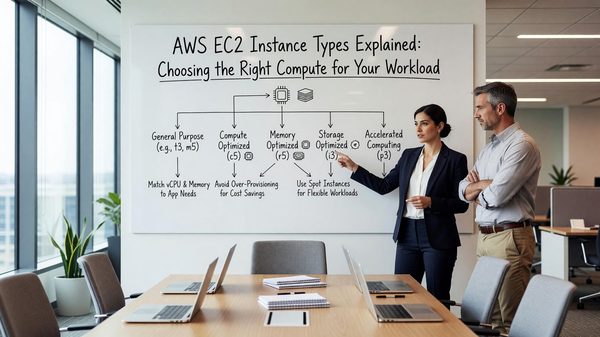
AWS, Azure, and GCP do not size “4 vCPU / 16 GB” identically. AWS’s m6i.xlarge, Azure’s Standard_D4s_v5, and GCP’s n2-standard-4 are the closest equivalents, but burst behavior, network baseline, and EBS/Managed Disk/Persistent Disk performance included in the base price all differ.
On-demand list pricing for this class of instance, per vendor documentation, lands within roughly 8-12% of each other across the three — GCP is typically the least expensive on raw on-demand compute, AWS and Azure trade the middle position depending on region. That gap closes further once each vendor’s discounting mechanism enters the picture: AWS Savings Plans, Azure Reserved VM Instances plus Azure Hybrid Benefit (relevant if the team already holds Windows Server or SQL Server licenses, rare for a modern SaaS stack), and GCP’s Committed Use Discounts plus automatic sustained-use discounts that apply without any commitment at all.
The sustained-use discount is a meaningful, often-overlooked GCP advantage for a 50-person team that isn’t disciplined about reservation planning: a workload running most of the month on the same instance family gets a discount automatically, layered on top of whatever committed-use contracts are in place. AWS and Azure both require an active reservation or savings-plan purchase to get any discount off list price.
Managed Database: The Line Item That Actually Moves the Needle
For a Postgres-compatible managed database at this scale (roughly 2,000 sustained IOPS, one replica, encrypted storage, automated backups), Amazon RDS for PostgreSQL, Azure Database for PostgreSQL Flexible Server, and Google Cloud SQL for PostgreSQL are broadly comparable in architecture, but pricing structure differs enough to matter.
AWS RDS bills compute (instance-hour), storage (per-GB-month), and provisioned IOPS (if using io2/io1 storage) as separate line items, which gives fine control but requires active tuning to avoid over-provisioning IOPS you don’t need. Azure Flexible Server bundles compute and storage into vCore-based tiers with IOPS scaling automatically with storage size, which is simpler to reason about but can mean paying for IOPS headroom the workload isn’t using. Cloud SQL follows a similar bundled model to Azure, with per-vCPU and per-GB pricing plus a separate charge for high-availability configuration (a second, standby instance).
For this specific workload profile, the three land within roughly 10-15% of each other on total database spend, with the actual ranking sensitive enough to storage-vs-compute ratio that it’s not safe to generalize — this is the line item worth actually pricing out with each vendor’s calculator against your specific IOPS and storage numbers rather than trusting a rule of thumb.
Egress: Where the Real Divergence Happens
This is the category where the vendors genuinely diverge, and it’s the one most cost comparisons underweight. At 15 TB/month of internet egress, published egress pricing puts AWS and Azure within a few percent of each other for the first tiers of egress, with GCP’s premium-tier network historically priced slightly higher per GB but its standard network tier priced more competitively — the tier selection matters more than the vendor at this volume.
The bigger lever than vendor choice is architecture: serving static assets and cacheable API responses through a CDN (CloudFront, Azure CDN/Front Door, Cloud CDN) moves that traffic to CDN egress pricing, which runs meaningfully cheaper per GB than origin egress on all three platforms, particularly at volume-discount tiers. A team serving 15 TB/month directly from compute instances without a CDN in front is very likely leaving a four-figure monthly saving on the table regardless of which of the three clouds they’re on.
Support Tier and the Line Item Nobody Budgets For
Business-tier support (not the free basic tier, not full enterprise) runs as a percentage of monthly spend on all three vendors, with tiered percentages that decrease as spend grows. At this workload’s spend level, business-tier support typically adds low-single-digit percentage points to the total bill across all three vendors — the percentages and thresholds differ by a few points, but not enough to be a primary decision driver on their own. It’s worth including in the total-cost model because teams that compare “compute plus database” numbers across vendors and skip support are comparing incomplete bills.
Observability and Logging: The Cost Nobody Models Upfront
Observability tooling is the line item that grows fastest relative to initial estimates, and the three vendors price it very differently. AWS CloudWatch charges per metric, per log-ingestion-GB, and per dashboard, with costs that scale roughly linearly with the number of custom metrics a team emits — a common surprise for teams that instrument liberally without considering the per-metric cost. Azure Monitor bundles Log Analytics ingestion and Application Insights under a workspace-based pricing model that’s more predictable at moderate scale but can produce a step-function cost increase once ingestion volume crosses a workspace’s included tier. GCP’s Cloud Monitoring and Cloud Logging follow a similar per-GB ingestion model to AWS, with a meaningfully larger free tier for logs than either competitor at this workload’s scale.
For a 50-person team instrumenting a dozen services with reasonable (not excessive) custom metrics and structured logging, observability costs typically land in the low four figures monthly on any of the three vendors — but the variance between “reasonable instrumentation” and “every team emits whatever metrics they want with no review” is large enough on all three platforms that this deserves its own governance, independent of vendor choice. Many teams that feel surprised by their observability bill aren’t looking at a vendor-pricing problem; they’re looking at an instrumentation-discipline problem that happens to be denominated in a specific vendor’s per-GB rate.
Committed-Use Contracts: The Negotiation Nobody at 50 People Thinks They Can Have
A common assumption at this company size is that enterprise discount agreements (AWS Enterprise Discount Program, Azure’s Enterprise Agreement rebates, GCP’s committed-use discounts negotiated directly rather than self-service) require enterprise-scale spend to access. In practice, all three vendors’ sales teams will negotiate committed-spend discounts well below the thresholds most founders assume, particularly for companies that can demonstrate a credible growth trajectory — a startup spending $15-20k/month with a clear path to 3x growth in 18 months is a normal conversation for any of the three vendors’ account teams, not an edge case.
The mechanics differ: AWS and GCP typically structure this as a committed annual spend in exchange for a percentage discount off list price across most services; Azure’s Enterprise Agreement adds Azure Hybrid Benefit value on top for teams with existing Microsoft licensing. The negotiating leverage a 50-person team actually has is real but modest — expect single-digit to low-double-digit percentage discounts off already-optimized spend, not the deep percentage cuts occasionally quoted for genuinely enterprise-scale (eight-figure annual spend) agreements.
What Actually Drives the Total-Cost Difference
Having priced this profile against all three vendors’ current published calculators, the pattern that holds is this: on-demand list price differences are modest (single digits to low teens, percentage-wise) and get further compressed by each vendor’s discount mechanism. The material differences come from three places — egress architecture (CDN usage matters more than vendor choice), managed-database configuration efficiency (right-sizing IOPS and storage tier), and how aggressively the team actually uses committed-use or reserved pricing instead of running everything on-demand.
A 50-person team that runs everything on-demand, skips a CDN, and over-provisions database IOPS will pay roughly the same premium — 20-30% over an optimized bill — on any of the three clouds. The vendor choice matters less than the discipline applied to any of them.
Related Reading
- For the deeper cost-optimization playbook once you’ve picked a vendor, see /cloud/cloud-cost-optimization-strategies/.
- For the architecture-level infrastructure comparison beyond cost, see /cloud/gcp-vs-aws-infrastructure-comparison/.
Frequently Asked Questions
Which cloud is cheapest for a small SaaS company? None is reliably cheapest across the board — on-demand compute differences are typically within 10-15% across AWS, Azure, and GCP. The bigger cost drivers are egress architecture, database right-sizing, and committed-use discipline, which matter more than vendor choice.
Does GCP’s sustained-use discount really beat AWS Savings Plans? For workloads that run continuously without active reservation management, GCP’s automatic sustained-use discount can outperform AWS on-demand pricing without any commitment. AWS Savings Plans can match or beat it, but only if the team actively purchases and manages the commitment.
Is multi-cloud worth it for a 50-person team? Rarely for cost reasons alone. Running the same workload across two clouds adds operational complexity and duplicated tooling costs that usually exceed any pricing arbitrage available at this scale. Multi-cloud makes more sense for resilience or specific best-of-breed service needs than for cost optimization.
How much does skipping a CDN actually cost at 15 TB/month egress? Serving that volume directly from origin compute instead of through a CDN typically costs several thousand dollars more per month at published egress rates, depending on vendor and region — often the single largest optimization opportunity in this workload profile.