Feature Flags: Decoupling Deployment from Release
Deployment vs Release
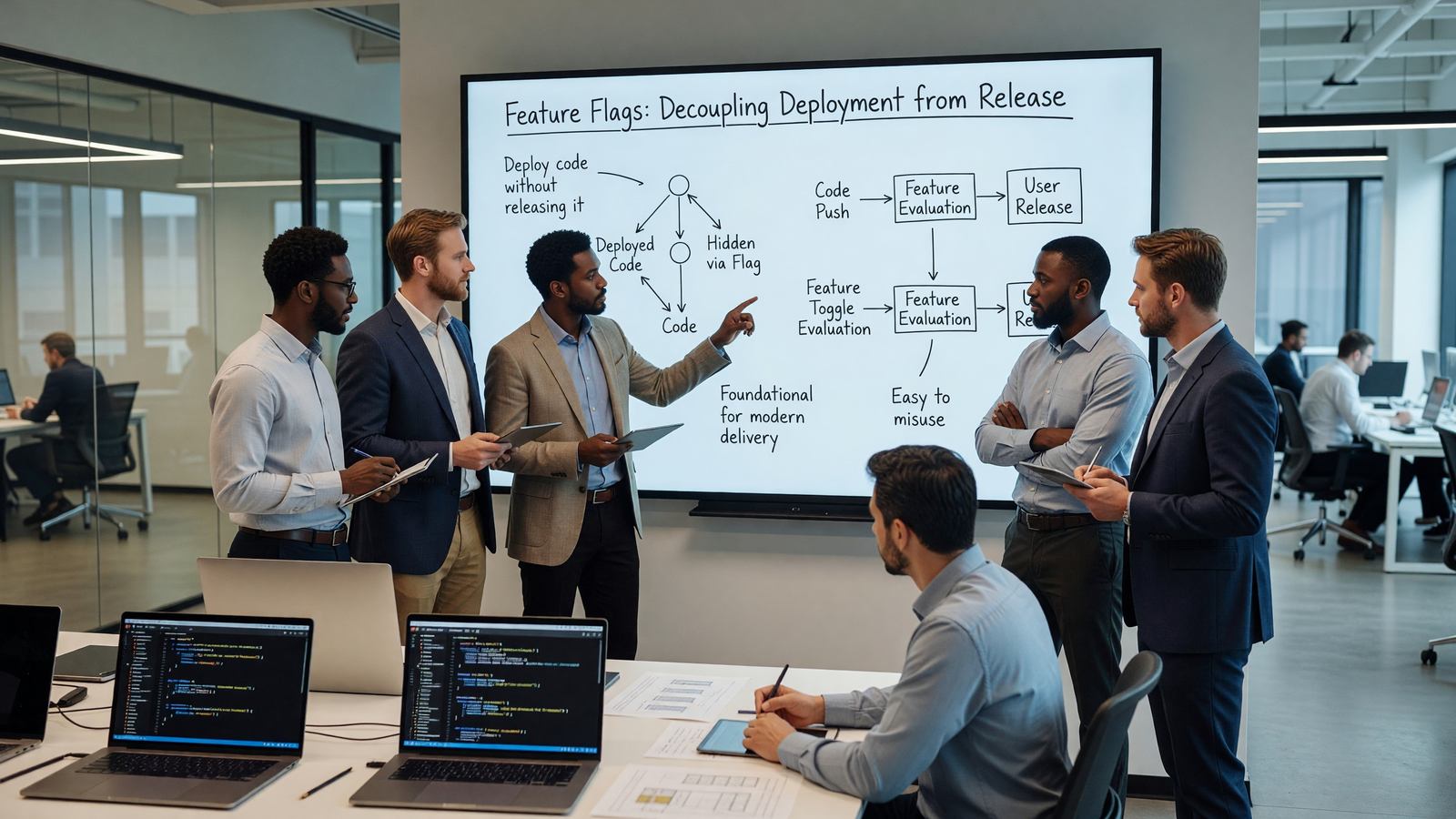
Deployment puts new code on production servers. Release exposes new functionality to users. Conflating the two — every deploy is a release — couples engineering risk to product risk and limits how teams can move.
Feature flags decouple them. Code can ship to production behind a flag set to off, then be enabled later — for specific users, percentages, or all users — without another deploy.
What Flags Are For
Three main categories: release flags (temporary, gate new functionality until ready), experiment flags (A/B tests with user assignment), and operational flags (kill switches, circuit breakers, dependency toggles).
Each has different lifecycle expectations. Release flags should be removed after launch. Experiment flags expire when the experiment concludes. Operational flags live indefinitely as safety mechanisms.
Flag Hygiene
The biggest failure mode with flags is leaving them in code after they’re no longer needed. Old flags accumulate, branch logic compounds, and removing flags becomes scary because nobody’s certain what depends on them.
Set lifecycle expectations on creation. Track flag age. Have a process for retiring flags. A flag older than 90 days that’s still serving traffic deserves a deliberate decision.
Build vs Buy
Internal flag systems (a config file, a database table, a redis key) work for small scale. They get hairy fast as features compound: per-user targeting, gradual rollouts, audit logs, and cross-service flag consistency.
LaunchDarkly, Split, Unleash, ConfigCat, and Flagsmith are the main hosted options. Unleash and Flagsmith have self-hosted versions. The buy-build threshold is roughly when you find yourself building targeting logic — that’s a sign the off-the-shelf option will save more time than it costs.
Operational Considerations
Flag evaluation must be fast. Hosted SDKs typically push flag state to the client and evaluate locally; full network roundtrips per flag check don’t work at production scale. The OpenFeature specification provides a vendor-neutral SDK standard worth considering for new implementations.
Flag failures need graceful defaults. If the flag service is down, every check should fall back to a safe value (usually off). Code that depends on a flag service being available to function has converted a soft dependency into a hard one.
Related Reading
- See our deeper guide at /cicd/canary-deployment-kubernetes/.
Targeting and Segmentation
Modern flag platforms support sophisticated targeting: by user attributes, by request attributes, by percentage with sticky bucketing, by date ranges. Use these capabilities to launch progressively.
Standard progressive launch: enable for internal employees first, then for beta users, then for 1% of customers, then 10%, then 50%, then full. At each step, measure error rates and key business metrics. Roll back at any sign of regression.
Flags and Testing
Feature flags add test complexity. A code path behind a flag needs to be tested in both states. Test suites that exercise only the default flag values miss bugs in the alternative path.
Treat flag combinations as test parameters. For services with many active flags, test each flag-on and flag-off combination at minimum; pairwise testing covers most interactions for combinatorial flag matrices. The Martin Fowler feature toggles article remains the definitive taxonomy of flag types and lifecycle.
Performance of Flag Evaluation
Flag SDKs typically push flag rules to the client at startup, then evaluate locally for each check. This means flag evaluation is microseconds, not milliseconds — no network roundtrip per check.
Initial flag download happens at SDK initialization. For serverless functions or short-lived processes, this overhead can be significant. Caching strategies (per-process caches, daemon-side caches) mitigate it.
Self-managed flag systems often skip this design and check flags via network call per evaluation. That works at small scale and breaks down quickly. Plan for the performance characteristics upfront.
Flag Migration and Cleanup
Removing a flag from code requires updating all the conditional logic that referenced it. Tooling helps: search for the flag name across the codebase, replace the conditional with the appropriate branch, run tests, commit.
Mass cleanup of stale flags is sometimes necessary when a system has accumulated technical debt. Some flag platforms offer automated PR generation for flag removal. Manual review is still required — the conditional logic can have side effects beyond just feature gating.
Build flag removal into normal development flow: when launching a flag goes to 100%, schedule its removal in the next sprint. The cost of removal is small if done promptly; large if deferred for years.
Release Notes and Changelog Generation
Automated release notes from commit history close the loop between code changes and user-facing communication. Tools like release-drafter, semantic-release, and changesets generate changelogs from conventional commits or PR labels.
The discipline of writing PR titles and commit messages for downstream consumption pays back here. PR titles become changelog entries; clear titles make for clear changelogs.
For libraries with external users, automated semver bumping based on commit type (feat: minor, fix: patch, breaking change: major) reduces manual version management. The same tooling can publish to npm, PyPI, or other package registries on merge.
Security in CI/CD
CI/CD systems hold significant power: they can build code, sign images, push to registries, and deploy to production. Securing them matters.
Standard hardening: least-privilege credentials for each step, signed artifacts at each stage, audit logs of all pipeline executions, separation between build environments and production credentials.
Supply chain attacks via compromised CI are a real and growing threat. SLSA (Supply chain Levels for Software Artifacts) provides a framework for thinking about CI/CD security maturity. Most organizations land at SLSA level 1-2; reaching level 3 requires real investment but provides meaningful guarantees.
Pipeline Templating and Reuse
At scale, copy-pasted CI configuration becomes a maintenance burden. Every change to the standard pipeline requires touching dozens of repos.
Templating mechanisms vary by platform: GitHub Actions composite actions and reusable workflows, GitLab CI includes and templates, Jenkins shared libraries. Each provides a path to defining pipeline logic once and consuming it from many repositories.
The pattern that works: a small platform team maintains pipeline templates; service teams consume them by reference. Service-specific customization happens via variables and minimal local overrides. Template changes can be reviewed and tested centrally before propagating.
Build Cache and Performance
Build performance compounds at scale. A 30-second improvement on every pipeline run translates to hours per day across an organization.
Caching strategies matter most: dependency caches (npm, Maven, pip), Docker layer caches, intermediate build artifacts. Each cache type has different invalidation rules and storage requirements.
Remote caches shared across runners deliver the biggest improvement for monorepos and matrix builds. Bazel remote cache, Turborepo Remote Cache, and Nx Cloud all provide this for their respective ecosystems. Build times that dropped from 10 minutes to 1 minute aren’t unusual.
Putting It Into Practice
The patterns described throughout this article aren’t all equally important for every team. The right starting point depends on current state.
For teams without consistent CI/CD: focus first on basic pipeline reliability and speed. Inconsistent or slow pipelines undermine every other improvement you might try later.
For teams with working pipelines but high change failure rate: invest in better testing, smaller deployments, and explicit rollback procedures. The shift from ‘shipping is scary’ to ‘shipping is routine’ transforms how teams operate.
For teams with reliable CI/CD looking to advance: progressive delivery, deployment frequency improvement, and DORA metric tracking are the natural next steps. Each builds on the foundation rather than replacing it.
The advancement isn’t linear, and not every team needs every capability. Match the practices to the team’s actual constraints and let the rest wait.
Key Takeaways
The most important point throughout this guide: practical engineering decisions depend on specific context. Best-practice recommendations are starting points, not destinations. The right answer for your team depends on your scale, your existing tooling investment, your team’s experience, and the specific constraints you face.
Three principles worth carrying forward regardless of specific tool choices. First, measure what you change. Engineering improvements without measurement become folklore — claims without evidence. Track the metrics that show whether interventions are working.
Second, default to simpler architectures and tools. Complexity has cost. Each additional moving part is something to monitor, debug, upgrade, and eventually replace. Choose the simplest thing that meets your actual requirements, not the most sophisticated thing you could build.
Third, invest continuously in the boring foundations. Reliable CI, good observability, sensible access controls, and clear documentation pay back across every project. Skipping these for short-term feature velocity accumulates debt that eventually consumes the velocity it was supposed to enable.
The teams that operate well over the long term are usually not the teams with the most exotic tooling. They’re the teams with disciplined fundamentals, deliberate decision-making, and continuous incremental improvement.
Frequently Asked Questions
How do I prevent flag rot?
Lifecycle expectations on creation, regular audits, and removing flags after launches. Track flag age as a metric.
Are feature flags worth the complexity?
For teams shipping daily, yes. For teams shipping monthly, the operational overhead may exceed the benefit.
Should I use a hosted service or build my own?
Build for very simple needs (kill switch). Buy as soon as you need per-user targeting or gradual rollouts.
How do flags interact with A/B testing?
Most flag platforms support both. Treat them as different lifecycles even when sharing infrastructure.